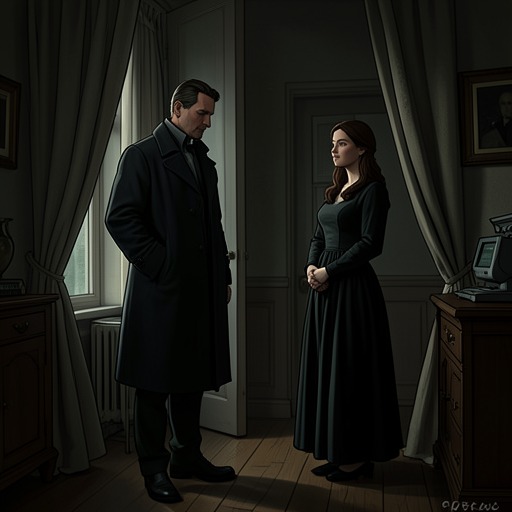
The death of the goose that laid the golden eggs
The Murder of Roger Ackroyd“The death of the goose that laid the golden eggs” is Hercule Poirot’s metaphor for the collapse of a profitable blackmail scheme when its victim can no longer bear to keep silent. The image makes greed self-defeating: the blackmailer presses for more until the person whose fear sustains his income breaks the arrangement by telling the truth, leaving exposure—and then murder—in its wake.
The Metaphor in Poirot’s Analysis
Poirot presents the expression as the turning point in a hypothetical portrait of an apparently ordinary man. A secret involving life or death offers him a chance to obtain money simply by withholding information. Silence becomes the first step: desire grows into greed, and the easy income begins to feel like a gold mine. Poirot’s sequence gives the metaphor its precise force. The goose is not merely a victim; it is the continuing source of the blackmailer’s gain, and its death marks the destruction of that source.
The metaphor follows Poirot’s account of a victim pressed too far. He argues that a woman who has deceived her husband may, in a moment of recklessness, abandon safety and proclaim the truth. Mrs. Ferrars’s confession to Roger Ackroyd supplies the case-specific meaning behind that analysis: once she speaks, the secret that made the blackmail possible is no longer safely contained. The blackmailer has gained money through silence, but the demand for more has helped bring about the end of that silence.
From Exposure to Murder
Poirot’s explanation does not stop at lost income. After the victim’s disclosure, exposure threatens the blackmailer with ruin. Poirot describes a man whose moral fibre has been blunted by greed and who, facing a losing battle, is prepared to use any means available. His analysis culminates in the dagger: the threatened man turns to murder. The goose’s death is therefore a hinge in the chain of cause and consequence, joining blackmail to the murder of Roger Ackroyd.
The surrounding investigation shows why the image belongs to a wider economy of concealment. Mrs. Ackroyd complains that Roger’s twenty thousand pounds went to Flora rather than to her, and recalls that he had provided for Flora by paying her bills while leaving mother and daughter with no money they could call their own. She also objects to the thousand pounds left to Miss Russell, whom she accuses of trying to marry Roger. These are Mrs. Ackroyd’s resentful claims, not a neutral account, but they place inheritance, household support, and financial dependence beside the murder’s more criminal bargain.
Ralph Paton’s history supplies another contrast between money and choice. After his debts enraged Roger, Roger later summoned him to Fernly and urged him to marry Flora. The engagement was a practical bargain for both: Flora saw a chance of liberty, money, and a wider horizon, while Ralph hoped his debts would be paid and that he could start again. His private marriage to Ursula Bourne complicated that arrangement, which he concealed from her. Against these different forms of financial pressure, Poirot’s metaphor isolates a particularly destructive transaction: money is obtained by keeping a secret, until the victim’s decision to reveal it makes the secret—and the scheme built on it—fatal.
Narrative and Thematic Significance
Poirot’s speech turns an everyday proverb into a compact model of the case’s moral logic. Its progression—from a hidden weakness, to silence for money, to escalating greed, to exposure, and finally to the dagger—makes the murder intelligible as the extreme consequence of a scheme that has already become unstable. The image’s vividness also sharpens the irony: the blackmailer’s source of wealth is alive only so long as the victim remains silent, yet his appetite for more helps destroy that condition.
The metaphor is spoken during Poirot’s final analysis, not offered as a detached maxim. He moves from the imagined ordinary man to the particular pattern of pressure and disclosure at the centre of the crime. The expression thus does double work: it names the moment the blackmail arrangement fails and helps explain why the threatened exposure leads beyond financial loss to violence. Its force lies in the reversal it captures—what seemed a dependable source of gain becomes the event that places the blackmailer in danger.